top of page

Join the Club

Subscribe to receive notifications when new posts are published to Accelearnate!

Thanks for submitting!

Looking for the start of the Accelerated Learning Roadmap for Success? Find it here.

Updated: Sep 20, 2025

               Now that Abby had determined the scope of the project to throw the party, created a schedule for her team to set up the party, and estimated the total cost of throwing the party, she could see how changes in any one of these three elements could affect the other. If extra items were added to the party, it would result in the party taking more time to prepare if any setup was required or costing more money if the extra items were purchased. So, an increase in scope would increase the amount of work time required or increase the cost of the project, if not both.


               If Abby waited two days to do any more work on the project, there wouldn’t be enough time to get all the work done, so she would be giving Nathan a smaller party, although she probably wouldn’t have to spend as much money on the ride punch cards, since her friends would have less work to do.


If the cost of ride punch cards were to double before Abby bought them (buying day-of instead of in advance), it would make her feel more inclined to buy cheaper cards that allowed fewer rides, and so she might then feel the need to assign her friends less work and put on a smaller party.


These are examples of what is called the Iron Triangle of Project Management (or the Triple Constraints of Project Management). Generally speaking, any change in one of the three elements of scope, schedule, or cost will cause the other two to change somehow as well. The hard part about working as a project manager is keeping scope, schedule, and cost all in balance so you don’t run out of time or money to complete the scope that’s needed by the end of the project.


               As Abby figured out how much work would be involved with certain parts of the party, she decided it was time to think about hiring some help from outside of the project team. She knew Nathan would really love a bouncy castle at the party, but neither she nor her friends or parents, had ever worked with a bouncy castle before. They could make every last party supply themselves, but some would be hard to do and would take a long time. There were just certain things that made more sense to pay someone else for than trying to do everything on their own, even if it might cost more money. With that realization, Abby started to make a plan for how to find the right help for the party.


               Abby began to plan procurement management, meaning she laid out the process by which she would identify what a vendor should do for the party and when, how she would identify appropriate vendors who could provide what was needed in the WBS, and from that, choose a vendor and arrange for them to work at the party. To do this, she would need to refer to several items that she had already made in other project plans. She would need to gather:


-        Scope and requirements documentation, to identify the scope of the vendor’s work

-        The risk register, to update certain risks as being addressed by the vendor

-        Activity resource requirements and the project schedule, to help the vendor understand what to provide, where, and when

-        Activity cost estimates to ensure the price of vendor help is roughly what it should be


Additionally, Abby would need to update the stakeholder register, stakeholder management plan, and communications plan with the vendor’s information and relationship to the project:


Stakeholder engagement assessment matrix shown earlier, now with the vendor added.


               Using the considerations above, Abby began to explore what vendors could help with the party by browsing the websites of some local party shops. She reviewed what they had for games and party gear, like hats and balloons. By reading reviews that others had left about the shops, Abby was able to assess their reputation and determine if one shop might be more reliable or provide better service than the others. In addition to seeing what vendors could offer, Abby also needed to ensure that anything she wanted to include at the party would be allowed in the park. All these considerations helped Abby to understand the possibilities and limitations on vendor help for the party. These are also examples of enterprise environmental factors (yes, there they are again) involved with procurement.


               Along with thinking about the possibilities for what a vendor could bring to the party, Abby made sure to think about how she would work with a vendor to make all the necessary arrangements. First, Abby needed to have a very clear idea of what products and services the vendor would provide, and when, and ensure she had a written agreement about the price charged by the vendor. Mom and Dad both made it very clear that getting a quote of how much each item would cost was absolutely necessary prior to pulling out her debit card they would put money on to pay for the party. An initial quote, plus any updates to the purchase list, would have to go through the change management and budget approval processes before Abby was allowed to buy anything from any vendor.


               “It’s not just important for you to manage money well here so the party doesn’t get out of control, Abby,” her dad explained. “Learning to manage money well is an important life skill. And you’ve seen how your mom and I get quotes from people we have over to do work on the house. It helps us to make sure we’re not getting overcharged or getting carried away and spending too much.”


               “Plus, if you ever decide to have a career in project management like your dad, this is good practice for that,” added her mom.


               As she browsed the different offerings of the local party shops, Abby noticed that there were a few different types of pricing for things they offered. In project management, vendors may offer a project manager different types of contracts, or written agreements to provide a specific good or service in exchange for money. One example that popped out to her was a vendor offering a mobile popcorn machine. It could be rented in one-hour increments, and she could buy oil and popcorn kernels by the pound. This is a simple example of a time and material (T&M) contract, where Abby would pay for the time of having the popcorn machine and also the material of oil and popcorn kernels, with some control over both cost factors. More often, Abby would see fixed-price contracts, where she paid a flat fee in exchange for an item. One thing she knew her little brother loved would be a baseball-themed bouncy castle, which was one of many items offered under this arrangement – for just $59, she could rent the bouncy castle for three hours and the vendor would even set it up, run it and take it down. There are other types of contracts you’ll want to learn about if you decide to learn more about project management, but these are two simple, common ones that you’ve probably seen before.


               With a good idea of what she wanted a vendor to provide for Nathan’s party, Abby started to shop around between the three local party supply stores more closely to see what each of them had to offer. Would their selections match up well with what she was looking for? To find out, Abby performed an independent estimate by checking the websites of all three stores, finding that they all offered what she needed in both complete packages and à la carte items. They all seemed initially competitive and appeared to meet Abby’s general source selection criteria for what they would need to provide. Abby proceeded further by viewing the items she was looking for from each of the vendors on different tabs of her web browser, enabling her to closely compare prices between the three vendors. She qualified for bulk order discounts with two of the vendors, and she factored that in and treated the grand total cost of similar packages from each vendor as their respective seller proposals.


               All the seller proposals were fairly good, although one shop’s package was a little bit cheaper, and Abby knew that they had helped to throw some fun parties around the neighborhood earlier in the summer. She sent that party shop an e-mail with her whole list of vendor requirements, to ensure they could meet all of them. This review of very specific requirements, including what exactly to provide, in what timeframe and where, forms what is known in project management as the procurement statement of work.


               Now that all the details were clearly spelled out, a nice man named Brian at the party shop offered a more specific list of costs for what they offered. Abby asked them about negotiating certain discounts, like if an item in the store was buy two, get one free, could they make an exception since she was buying a whole package, and allow her to buy two for one on that item instead? Then she could buy the exact number she needed and not have to buy more than that to get the discount. They also offered her some good deals on some of the items as an incentive for her to choose their package. This back and forth to try to reach a final agreement with a vendor is called procurement negotiations. It would allow Abby to ensure she had exactly what she needed, and to get it at the best possible price.


               After all the work to define the procurement requirements, Abby was finally ready to formally select the vendor (or seller) that she would hire to help with the party. Seller selection can be very complex on a work project and can even involve teams and processes that go beyond the project manager, but for Abby it was pretty simple. She decided to use the party shop that had been in the neighborhood earlier that summer, as the detailed negotiations didn’t sway her decision much toward one vendor or the other. Now, Abby just needed to confirm approval in the budget meeting with her project sponsors before placing the order.


               With all the party material costs, estimated risk costs and procurement costs factored in, Abby was ready to put together a complete party budget proposal for Mom and Dad to review; she had assembled the project’s cost baseline, which would form the initial project budget to be proposed to the sponsors. She hoped they would approve it! To help Abby’s parents keep track of how much money was being spent on the party, they asked her to make a table of how much money she was planning to spend each day. This way, Abby and her parents could closely monitor and control the amount of money being spent during the project.


Having an estimate of how much money each part of the project would cost, Abby presented the costs and the timing of each expenditure to the sponsors for approval of the proposed budget. She made a table to show the funding requirements for each day to help her parents clearly understand the expected cost. What would be the daily funding requirement to pay for everything at the right time as the project unfolded? Planning ahead for this is important because it’s easier to influence the cost of a project earlier on, and it steadily becomes more difficult later on as more money is spent.


Figure of the completed budget table with total budgeted costs by day, earned value so far.


               Abby now had a snapshot of what her cost, scope, and schedule all should look like and how they would relate to each other. Now that a full cost estimate was in place, Abby presented it to her parents. After a thorough review and some discussion, Abby’s parents felt comfortable with her plan to execute the project. They loaded the requested funds onto the debit card Abby would use to purchase the party items.


In addition to budgeting an expected cost of the party that assumed everything would go well, Abby thought it would be good to have some wiggle room in the budget in case an unexpected expense was required, or if something turned out to be more expensive than she had assumed from her research (these things are often called unknown-unknowns). She thought she could convince her parents that fifty dollars would be an appropriate amount of management reserve funding for the project, which would only be used after submitting an additional spending request through the project’s change control process and getting sponsor approval to spend extra money. When she ran this by them, they agreed that this amount was a good total management reserve amount, and that they could load up to that amount of money onto the card later on after reviewing and approving any requests for it.


               After getting the budget officially approved by her sponsors, Abby reviewed her project documentation for any updates that needed to be made. Going back to the quote for the order she had discussed with Brian from the party shop, Abby was now able to place the order. In placing the purchase order and reviewing the fine print in the order review page of the party shop’s website, Abby ensured that the agreement implied in the order was exactly as they discussed and would cover everything Abby needed for the party. Entering in the payment information for the card her parents gave her to use, she clicked Confirm at the bottom of the page and then made sure the confirmation e-mail came through, in case she would need to review it later.


Next post in the series: The Iron Triangle of Project Management


               As a thank you to her friends, Abby came up with an idea to “pay” them for their help. She wanted to surprise them after the party with a carnival ride punch card for the fair that would be in town the next weekend. Would this fit within the cost constraint set by her parents? There were a few different prices to choose from, and she thought it would be great since the fair was such a special event for them every year. To get it all worked out, Abby made a plan to determine how much the project would cost with everything purchased and then added to that the cost of getting a punch card for each of her friends.


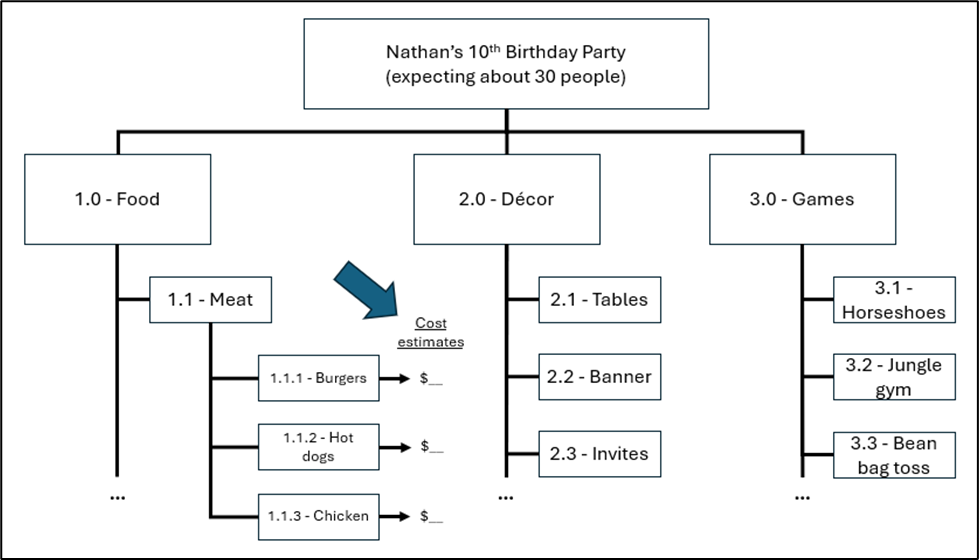
               Abby needed to plan cost management to help her to estimate the project’s costs. She reasoned that each piece of scope for the party would have some kind of cost associated, at least for purchased or rented items. Even for something like making the cake at home, there would be a cost of ingredients. If the money isn’t there to buy what’s needed for a piece of the project scope, how will that scope get accomplished? So, Abby created a copy of her WBS that she could use to record cost estimates for each WBS item. For now, she was just making the template but would use it soon when it came time to estimate costs.


Copy of WBS for adding cost estimates for items.


               Once Abby had estimates of the project’s costs, she would need to make sure those paying for the project agreed that the costs were reasonable. In other words, as the project manager, she would present her cost elements and overall cost estimate to the project sponsors for their approval. If they thought the project was too expensive, she would have to discuss with them how to reduce the cost, probably by choosing some scope items to reduce or eliminate and thereby cutting their corresponding costs. In addition to initial approval of the budget, Abby also wrote down what she would do to ensure Mom and Dad approved any changes in spending in case something ended up being more expensive than planned. She figured running requests for additional spending by them ahead of time was better than overspending and then trying to explain it after the fact.


After getting costs estimated and a budget approved, Abby would need a way to control costs. Again, this meant control in the project management sense, so tracking how money was being spent and making adjustments to spending if the actual spending was significantly different from the planned spending. In project management, the practice of gathering and analyzing data for controlling both cost and schedule is known as earned value management [14]. To get started on this, Abby was able to make a simple spreadsheet table with each day of the project across the top row, and the row below that having the budget to spend for that day, known in project management as planned value [15]. Knowing that the actual work might not go exactly to plan, Abby included a row for earned value [16] to measure how much of the planned value was accomplished by the end of each workday. Lastly, Abby created a line for actual cost [17] in the bottom row, so she could easily compare the anticipated cost of the project and what was achieved against what was actually spent.


[14] Project managers perform earned value management to track cost and schedule health for their projects by taking three basic measurements: planned value, earned value, and actual cost. Various metrics are computed from these three raw data measurements.

[15] Planned value is the scheduling of daily project activities in the form of dollars spent instead of time taken to perform the activities. If $200 worth of activities are planned to be accomplished on a given day, that day’s planned value is $200.

[16] Earned value is the monetary measure of how much work was actually accomplished on a given day. If the planned value for the day was $200, but only $180 worth of activities were completed, the earned value for the day would be $180. Earned value is compared to planned value to assess project schedule performance.

[17] Actual cost is the measure of how much money was spent. If the planned value for the day was $200, and the earned value was $180, but only $160 was spent to accomplish the $180 worth of work, the actual cost for the day is $160. Actual cost is compared to planned value to assess project cost performance.


Budget spreadsheet template.


Later on, after the end of the project, Abby would use her spending information to create an expense report to verify the exact actual cost of the project and reconcile it against the debit card balance that Mom and Dad would loan her to use for the project. Since Abby was tracking planned and actual costs in order to control cost, this would be pretty straightforward and would be bundled with receipts from every transaction into a report for her parents to review. This is one of the last things Abby would complete the day after the party, once all transactions had been finalized.


               With the process for estimating the required project costs in place, Abby was ready to go through the items in scope for the project and make a reasonable guess at how much each would probably cost. She based these estimates on the costs of things like cake ingredients from the grocery ad, checking the city website for a park pavilion rental fee and looking at party packages for renting party games and gear.


Cost estimates added for WBS items.


After completing and adding up all the WBS item cost estimates, Abby next made a three-point estimate for the cost of the different punch cards she considered buying for each of her friends:


-        A 5-ride pass for $7

-        A 10-ride pass for $10

-        A 15-ride pass for $14


Abby had seven friends helping with the party, so for the seven punch cards she would need to buy, she had three points of cost that ranged from $49 to $98. While a 5-ride pass was better than nothing, Abby felt they were giving her enough help to deserve more than that. On the other hand, if her friends did a lot more work than expected to put the party together, Abby was going to make the case to her parents that they should get the 15-ride pass. But really, she knew they would likely agree on the 10-ride pass being the most appropriate option, since the $28 dollar cost difference between those two options made a substantial difference in the cost of the party.


After totaling the cost to do all the work, including the cost of the punch cards, Abby finally had activity cost estimates for the project. This was supported by a basis of estimates; cost estimates were based on the scope of the WBS and various sources telling Abby the cost of the items needed. She completed relevant project document updates like noting risks of cost variations and how she would keep her parents posted about the budget consumed versus what she was expecting to spend on a given day.


Abby had to make many decisions in the process of estimating the costs. For example, several make or buy decisions were made to balance between the party getting too expensive on the one hand or getting too hard to do on the other. They could have chosen to buy a pre-made birthday cake and saved Mom a lot of baking time, but it would have cost three times what making the cake would. Plus, since Mom loved to bake, it was a no-brainer to make instead of buying this item. On the other hand, the “buy” decision to rent the bouncy castle was easy because it would have taken them days to make one themselves. The “buy” was in quotation marks because they rented instead of buying, with Abby’s parents reasoning that it was only a good deal to buy a bouncy castle if they had plans to use it at least three times, which they didn’t. This was a buy or lease decision where renting made more sense than owning.


Once Abby had estimated the cost of each work package in her WBS, she added them all together with the cost of the punch cards and an allocation for a party package to form a bottom-up estimate, showing how all the individual cost components accumulated into a total project cost.


Drop Me a Line, Let Me Know What You Think

© 2026 Accelerated Learning, LLC.

bottom of page