top of page

Join the Club

Subscribe to receive notifications when new posts are published to Accelearnate!

Thanks for submitting!

Looking for the start of the Accelerated Learning Roadmap for Success? Find it here.

Project Monitoring and Controlling


After sleeping hard all night from all the work she had done, Abby awoke to the start of Nathan’s 10th birthday. Her eyes shot open and she sprang out of bed, both nervous and excited to get to work as soon as she could. Quickly getting ready and having just enough breakfast to feel ready to tackle the day, Abby wasted no time getting to work on the remaining tasks for the party. She let her friends know that she was on her way to the park with a wagon full of decorations and other supplies to be set up.


With her team soon helping to set up at the park, Abby oversaw their work and provided feedback as needed, going between the kitchen and the house several times to check on food and cooler prep and the setting up of tables and decorations at the park a few blocks away. As project tasks continued to be completed by all her helpers, Abby kept comparing how their pace of work was going against the schedule she had planned. By ensuring that work continued on schedule and on budget, taking corrective actions to get back on schedule or budget when needed, Abby performed monitoring and controlling project work.


While ensuring the play areas and games were ready for the party, Jason asked about marking lines on the ball field to make it fancier for Nathan and his friends. He had some time to spare and was experienced in this from his job as the school’s football field groundskeeper.


“That would look really cool, Jason,” said Abby. “But we don’t have any spray paint, and I don’t have any money to spare in the budget to go buy any. If we bought some spray paint and did the work of drawing field lines when that wasn’t part of the project plan, that would be scope creep.” She went on to explain to him how scope creep is a major cause of project failure, as more and more scope keeps getting quietly added to the project plan without official change requests and approvals. The result of this is that there is more work to be done than there is time or money to get it done with.


Abby pulled up her project management plan and reviewed the schedule baseline, zooming in on the part for the activities she needed to review next. She gathered work performance data by comparing what tasks were complete to what was expected to be done by then. For example, how many food items had been made versus the number planned? From this and other work items, Abby was able to estimate a rough schedule performance index (SPI) calculation to tell if the project was running on schedule. The SPI is a fraction of the total value of project tasks that have been accomplished divided by the total value of tasks that should be done by that time. An SPI of less than one means the project is running behind, and an SPI of more than one means the project is running ahead of schedule.


While it wouldn’t be good enough to handle a large project in a professional setting, Abby had been able to use a spreadsheet program on her tablet as project management software to create and monitor her project’s schedule. She had project activities listed down the rows, with marks to show when they were to start and when they were to finish, even listing the dependencies so one task wouldn’t start before its predecessors were all done. Thanks to having produced this over the course of her project planning earlier, Abby now had a handy way to monitor and control the schedule for the rest of the project.


Sample set of project activities Abby managed in her spreadsheet program.


What Abby did in reviewing the rate of a task’s progress, noticing anything was not quite according to plan, and redirecting her team to address the discrepancy is a process known as controlling schedule. By Abby controlling the schedule (and similarly for scope and cost), it’s not that she is micromanaging her team, she is just comparing actual schedule, scope, and cost performance to the planned performance and adjusting the focus of her team’s effort as needed to get back on track. Abby also reviewed her other plans to ensure that they were updated as needed based on the adjustments she made in response to schedule variances. A variance is a difference between what was planned and what was the actual result. She also made notes about the adjustments to refresh her memory if she were to reference them in a future project, adding more data to her collection of organizational process assets.


Abby kept an eye on everything going on as the party was being set up. She had thought about some risks and wanted to ensure that she stayed on top of anything that might come up. Pulling up her risk register, she scrolled through her highest priority risks and went down the list. There were some clouds and a chance of rain later, but the sky still looked nice for now. Brian from the party shop had just arrived and was starting to set up the bouncy castle, so she would have to check on that soon…


“Ouch!” she heard Benjamin exclaim while he was hanging a banner on the picnic shelter. “I got a sliver in my finger. Does anyone have tweezers for taking this out?”


Everyone was concerned and looked for a way to help, but Abby sprang in prepared with her first aid kit! Even though the sliver was small, she was able to get it out with the tweezers in her kit, and she also cleaned his finger with some rubbing alcohol and put on a bandage with a little antibiotic ointment. She successfully employed the risk response she had planned in case anyone had a minor injury while working on the project.


“Alright, Benjamin, you’re all set if you want to keep working. Otherwise, I think we’re getting everything done fast enough that you can take a break if you’d like.”


“Thanks for offering, but I just have a little bit left to do here. Why don't I just keep going?”


“Thank you for continuing to help, but you should wear these work gloves that my dad loaned me in case someone might need them,” said Abby.


With Benjamin’s sliver taken care of, Abby continued to review her other high priority risks. The garbage cans were in a good spot and the food items had been chilled with ice and covered tightly as they were set on the serving table. Dad had the meat in a cooler of ice and had the meat thermometer ready to use. It seemed like the big risks were being addressed well. The party was set to start soon, and Abby’s big concern now was a good turnout from Nathan’s friends. And the scary thing about this risk was that there wasn’t anything she could do to control it. She simply had to accept this risk.


---


While Abby was at the party shop the day prior, she saw a five-pound bar of milk chocolate and was reminded of how much Nathan loved the little chocolate squares in the kitchen cupboard. She texted her mom to see if the money to pay for this huge chocolate bar could be added to the budget since Nathan loved chocolate so much.


“Sure!” her mom cheerly texted back with a big smile emoji.


Making this change request and getting sponsor approval is an example of controlling costs. Controlling costs doesn’t always mean saying no to spending any extra money. There might be a convincing reason to spend more money than originally planned. It’s just that changes to the budget need to be controlled by explaining the reason to the people in charge of the budget.


After recalling this event, Abby decided it was a good time to review her budget spreadsheet and the earned value management (EVM) metrics to see how her project was turning out.


Put planned versus actual budget spreadsheet, including the approved chocolate bar variance.


Basic project financial health calculations. A cost variance > 0 and a CPI > 1 mean spending is within budget.


While Abby was reviewing her risks and costs, Brian had finished setting up the party package that Abby had purchased. With the bouncy castle up, it was time for Abby to do what is called control procurements. She pulled up her procurement management plan on her tablet and went to her checklist of vendor provided items, which would be used to make sure everything from the party shop was in place and ready as planned. There were some specific items in the order receipt and the rental agreement that comprised the contract with this vendor; reviewing the checklist of specific requirements that she had for this vendor is what’s known as a procurement performance review.


First, was everything set up on time? She had told Brian when she ordered that she needed it all set up fifteen minutes before the party would start and would pay for that setup time. The party was still about twenty minutes away, so this requirement was met.


Some items from Abby’s procurement performance review checklist.


Next, Abby wanted to perform a quality check, also known as an audit (another word for inspection), by trying out the bouncy castle herself. Brian showed her how much pressure the bouncy castle had and how that compared to the pressure that was normal for bouncy castles. It was a little higher than average, but still within the green area of the gauge that represented the recommended pressure range.


“Looks like you’ve pumped the castle up all the way. If you don’t mind, I’d like to try it out before my brother and his friends get here.”


“Sure, no problem. I made sure there’s enough pressure to give them good air when they bounce,” Brian told her.


---


After trying some flips and tumbles in the bouncy castle, Abby got back to work and pulled up her project management plan to review communications. She had planned this out earlier, informed everyone about what they needed to know to start work, and now she needed to review how communications went and make any necessary adjustments. This is called controlling communications. It’s not about controlling what gets communicated, it’s evaluating how well communications are happening versus the plan and making changes to communications as needed. What’s working and what’s not?


Once again, Abby continued marking tasks complete as they were finished, and she texted her parents from the park or gave them in-person updates at home to keep them up to date. She also got a few questions that were posted on the issue log – her food team was coming back from one last trip to the house but first needed help finding a few extra food containers, the new bottle of mustard, and a tub to hold any dirty dishes that would need washing after the party. Abby and her team kept working through the plan and communicating together as updates or new issues needed to be shared back and forth.


With party preparations progressing rapidly, Abby wanted to review how relationships with the stakeholders were going again. She kept everyone informed about how things were coming and checked around to see if anyone needed anything they didn’t already have. After checking with everyone, Abby took a moment to consider if there were any new or missed stakeholders she should add to her register, but she ultimately decided that her list of stakeholders was still thorough and comprehensive.


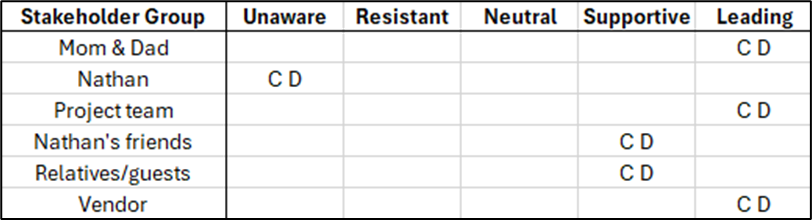
Abby had various stakeholders who had different levels of influence and interest in the project, and she had to interact with them accordingly to manage any impact they might have on the project, as well as how the project might impact them. This is the essence of managing stakeholder engagement. Responding to how the stakeholders interact with the project as compared to the plan is slightly different from initially engaging them, and this is called controlling stakeholder engagement. It’s not controlling what the stakeholders do, but rather it’s taking action to bring the relationship between stakeholders and the project back into alignment with the plan for how they should relate, as called for in the stakeholder management plan.


A simple example of controlling stakeholder engagement would be how a few of Abby and Nathan’s cousins showed up bummed out to not see a movie that was coming out in theaters that day. They had looked forward to seeing this movie for the past month, and they were neutral, if not resistant stakeholders about coming to the party today. How did Abby get them back to being supportive stakeholders? She knew that her cousins really liked chocolate covered peppermints, so after checking with their parents, Abby offered to take them to the movie the next day and buy one for each of them at the theater if they just had fun and stopped worrying about missing the movie during the party. Next thing she knew, Abby’s cousins were having fun chasing after each other in a spirited game of tag around the park's jungle gym.


Project Execution


With all the plans in place, it was time for Abby and her team to start setting up for the party! It was so exciting for all of them to finally start executing everything they had planned together. Abby felt a great sense of excitement and anticipation, but along with it, some nervousness. This was the big time when work would be done and money would be spent, and it would be a lot harder to stay on track if things didn’t go well. Thankfully, Abby knew she had good plans, and that part of project management is tracking progress and adapting those plans as the project unfolds. So, the fact that they were starting the work wasn’t too stressful for her, or anyone else on the team.


“As we start the work activities on this project, I want to thank all of you again for taking the time to help me with all of this. It would be way too much for me to take on alone, and you guys are really showing me what friends are for,” Abby beamed as she told her friends in their first meeting of the project’s execution phase. She really was so happy that they had her back for something as important as her little brother’s birthday party.


As planned earlier, Abby gave everyone some safety training for how to safely perform activities like moving picnic tables and handling hot items or sharp tools. While she admitted a lot of the things she said were common sense, Abby wanted to make sure everyone had a fresh reminder to be safe and keep others safe during the project work.


“I know it sounds silly, but you’d be amazed at how often people forget that,” said Abby, recounting a story from the first aid unit of the health class she had taken during the previous school year.


After the safety briefing, Abby’s friends were eager to hit the ground running. Before she had assigned the work tasks to her friends, Abby had decided she should ask people if they want to do a particular job instead of just requesting them to do it and even give people a choice of jobs if it was convenient. While she knew they were happy to help her in any way necessary, she still thought it was important to make sure they were doing work they actually wanted to do. This is an example of how interpersonal skills could help to make the team more motivated and dedicated to their work assignments by allowing people to have a say in what work they do.


“Okay, so here are the tasks that I have for all of you to help me with,” Abby said as she e-mailed the task lists that she had made for each person, for their reference. “Let me know if you have any trouble reading these lists on your phones and be sure to go down the list from top to bottom instead of skipping around, as the first task on your list might have to get finished before the second or third task on someone else’s list can start. If you get stuck on anything or start running into a problem, let me know right away so I can come help you with it.”


In addition to diligently performing tasks in the correct order, Abby also asked her friends to observe some other ground rules as they started working on the party. She asked that they:


1.      Measure twice, cut once. This would save time and avoid wasting materials during activities like making the party decorations.

2.      If unsure how to do something, ask for help. Asking for help is nothing to be embarrassed about, and nobody is expected to know everything.

3.      Embrace change and be flexible. As work is getting done, there are many possible reasons why people may have to be reassigned from one job to another or asked to do different tasks.


With tasks in hand, everyone went to stations that Abby and her parents had set up the night before to get to work. Abby walked around and did one last check at each station to ensure nothing was missing and everyone was able to proceed with their first task. As different pieces were produced, she and her dad would move items between tables as they were finished; Katie, Jess, and Hannah put pieces of candy into bags that would be given to everyone attending the party to take home afterwards, and some extra bags that would serve as balloon weights. At the other table, Benjamin was cutting ribbon for the balloons while Jason and John tied the ribbons to the balloons and the candy weights that would hold them down. Having everyone on the project team working together in the same area like this is known as collocation, and this is helpful both for management oversight of work and for team members to be able to work together effectively and help each other to overcome obstacles.


Abby gave Jason and John some training on how she wanted the balloons tied with the ribbons, so that they would leave a few feet of ribbon at the end. She then also trained Benjamin on the second part of his job, which was to curl the ribbon with the edge of a metal ruler her dad had provided. This job was a little tricky to do right, so she wanted to demonstrate and coach him through it with a few practice strands of ribbon. Soon, he was a pro at it and the ribbons had a playful twirl coming down from the balloons. Providing training like this to ensure everyone had the tools and skills to do their work on the project is called developing the project team.


On larger projects, teams may have recognition and reward programs to recognize when a team member works especially hard or makes an important contribution during a specific period. Here, Abby wanted to avoid elevating any one of her friends over the others; the group was small and close enough that she felt like it would be smarter to recognize the team as a whole and to personally recognize and appreciate the work that each of her friends was doing. Giving them a sincere thank you or complementing the way they were working would show team members that they were valued and would motivate them to continue working toward a successful outcome.


Besides ensuring everyone was getting work done effectively, Abby also assessed the way in which people were interacting with each other and how they were approaching problems. Observing how project team members do their work and interact with others is important for understanding each person’s strengths and weaknesses, or how they prefer to do things, for the purpose of ensuring they’re in the right roles and that they are placed in the right roles in the future. In addition to watching how they work to gauge their ability, Abby asked people why they chose to work the way they did. She also asked if they thought they had been assigned the right work or if they thought they could be more helpful doing another task. Watching the team work and asking questions like these are examples of personnel assessment tools that help a project manager to be an effective team leader. Using these tools helped Abby to better understand her team’s ways of working, as well as to ensure everything was going well for them and that she would be aware of any adjustments needed.


As everyone worked away on their tasks, Abby kept an eye on how well they were meeting quality requirements, keeping to the schedule, and efficiently using the right amount of materials to keep costs under control. Was the team working well as a whole? Were there any training needs or other assistance Abby needed to provide that wasn’t noticed in individual assessments? Abby asked herself questions like these as part of performing an overall team performance assessment, measuring the quality and timeliness of completed work items to ensure the team was on track to finish their work on time.


As work went on, Abby continued to go around to make sure everything looked good. She saw that one of the balloons seemed to be barely secured to its candy bag, so she took a closer look.


“Hey, John,” she mentioned. “Most of these look good, but this one here isn’t tied to the bag very well. It looks like there are seven pieces of candy in it and there should be just six, so feel free to remove a piece when you see this so that the balloon cord can be tied on correctly and won’t come loose.”


“Oh, thanks for pointing that out, Abby,” John replied as the cord slipped free. He grabbed it before the balloon could float up to the ceiling. “I thought one of those was hard to work with, but I didn’t know it would be okay for me to do that. Thanks for letting me know.”


Right there, Abby was assigning tasks, reviewing work and providing feedback as part of managing the project team. She knew what work needed to be done and what different items should look like, and she ensured that her team was making items correctly and helping them out when they needed it. In this specific case, Abby was performing quality control by reviewing the work on the balloons and identifying a case where the work was done differently from the expected standard. When she did this, her feedback alerted John to the issue, and he then engaged in what is called defect repair to ensure that balloon wouldn’t come free from the bag again at the party and float away into the sky.


With her friends performing their work smoothly, Abby came into the kitchen to find her mom already hard at work.


“Wow, Mom!” Abby exclaimed, “It’s so exciting that you’re starting the cake now!”


“I know you wanted to help but would be too busy getting everything else together, so did you get the design finalized for me to use?”


“Yup! Here you go. Here’s a picture of the cake design, and I even made a checklist to help you get through it a little faster.”


Abby had made an intricate baseball field design, using things like green coconut for the turf and dots of colored icing for the fans in the bleachers. Because it was complicated and had to be ready in time for the party, Abby drew a picture and made a quality checklist, as well as a list of quality metrics for her design so her mom could make sure she didn’t miss any details of it.


As Abby’s mom baked the cake and got it decorated, she marked the checklist on her tablet with the completion of each step. She ensured the cake was baked by poking a toothpick in and pulling it out (inspection of the cake for doneness), and she marked each decoration item complete as it was finished, like when she finished putting the colored icing fans in place. This sort of work performance information would all be kept as part of the organizational process assets, as reference information for how this project went and how a future project might be done. By confirming each checklist item as successfully completed, Abby’s mom created a record of quality control measurements. Abby took a look at the cake and reviewed the checklist, confirming the cake as a verified deliverable that met her specifications. With this, Abby updated relevant project documentation to reflect the completion of the cake, including marking the cake making task complete on the project schedule.


---


Communication is at the center of every project manager’s job, and this was no different for Abby. Communicating with her team didn’t stop with handing out the task lists for her friends to complete. She had to give them feedback and ensure they knew to ask her if they needed any help or finished their tasks sooner than expected. Even as they worked, Abby had to keep checking on everyone to make sure they were able to continue working smoothly, promptly helping or gathering supplies if anyone needed it.


Abby used many ways of communicating with everyone to run her project. She e-mailed directions to the park so everyone would know where to go for the party. She submitted an online shopping order to the party shop to have the bouncy castle. When a significant job finished, Abby checked off that item on her to-do list and sent a notification to Mom and Dad based on that updated the project’s work performance information. While Abby used her tablet for a lot of communication, she always made sure to talk to people face to face whenever she could. She knew that ultimately, her team of people was getting the work done, so she wanted to maintain rapport and keep everybody feeling dedicated to the project. Talking face to face is the best way to talk when information doesn’t need to be written down for reference later. It makes communication more human and more connected, and the tone and body language also communicate a lot more than words alone.


A big key to a project manager’s success is knowing the right mode of communication for the right situation.


--- 


While her friends continued to work on the scope items for the party that afternoon, Abby decided it was time to review her plans for managing the stakeholders of the party to ensure they were engaged the right amount. Stakeholders have the most influence at the start of a project and gradually lose it as the project gets closer to the finish. At this point, support from stakeholders was crucial to the success of Abby’s project. She looked over her stakeholder register and plans for stakeholder management and communications, and decided it was time to reach out to the different stakeholders. With her list of stakeholders and their role and level of interest in the party preparations, as well as guidance from the communications plan about the best way to contact them, Abby was all set to reach out to people and ensure their involvement at the right level, which is called managing stakeholder engagement.


Based on her communications plan, Abby needed to make sure Nathan’s friends and relatives had all the information they would need about the party. Starting with Nathan’s friends, Abby mailed an invitation to each of them, with a bright green sticker urging them to keep the party a surprise for Nathan. Their job was really just to show up a few minutes early and be part of the big welcome for Nathan, and they could play catch to pass the time while they waited for the party to start. Abby let them know they didn’t need to bring anything, they could just show up and have fun.


With Nathan’s friends informed and ready to do their part, Abby started by contacting the relatives by text or phone, asking if they could bring a certain dish to share at the birthday meal. Over the years, they had brought a lot of great recipes to family gatherings, and she knew these dishes would be a great addition to the meal. There was a risk that someone would be late to the party if they had to prepare something, or maybe they’d be bummed if not many people ate what they brought, but Abby thought it was worth the risk of inviting aunts, uncles, and grandparents to contribute to the party. She knew that just the chance to do that would make them feel good, and the benefit outweighed the risk.


Next, Abby called the party shop to ensure everything was still going to be ready as planned. Unsurprisingly, Brian told her everything was all set and she wouldn’t need to worry about it, but she also wanted to know if there was any other information that he needed to set up their equipment. They confirmed the specific pavilion and the meeting time, along with all the items, just to make sure nothing would be missing. Abby felt good about the vendor being ready to do his part at the party.


All stakeholders have now reached the desired level of stakeholder engagement.


To make sure everyone was involved in the right ways and that they were happy with how the party was developing, Abby didn’t wait to follow up with stakeholders. She had made a plan ahead of time to remind herself who to communicate with, how often, and by what means. Not only was she counting on several stakeholders to make the party successful, including her friends on the project team, but she also wanted stakeholders like her parents to rest assured that everything was well taken care of. Keeping stakeholders informed of the status of the project is important for keeping them from interfering or asking so many questions that it becomes hard to get work done.


So, the next stakeholders Abby engaged with were Mom and Dad. She frequently updated them on her plans for the party, but now she was about to give them a tour of everything that her friends were working on.


“Here’s the WBS we made together to organize everything we’d be doing for the party. You can see everyone at the tables doing these things, and they’re all making good progress on their work. Also, I called the party shop, and they have everything ready to bring to the park and set up tomorrow,” Abby explained to her parents.


“This is great, Abby! Clearly, you’ve put a lot of thought into this, and I feel like you’ve definitely got this under control. I’m glad we gave you the chance to put on this party for your little brother,” Abby’s mom exclaimed, beaming with joy.


Just as Abby thought she had all her stakeholder interactions taken care of, one relative called back asking if she could bring a dish that someone else was already bringing. As much as Abby didn’t like to say no, she recognized that having two people bring the same thing didn’t really make sense. This was a situation that called for a technique called conflict resolution. To allow the first person to bring the dish and this relative to still have a chance to make it, at least eventually, Abby offered to let her relative bring it for Abby’s own birthday coming up in a few months. After the call, Abby noted this situation of two people asking to bring the same dish on her list of lessons learned for managing stakeholder engagement in the future.


To wrap up managing stakeholder engagement for the time being, Abby sent notifications to everyone regarding their points of interest about the party. She e-mailed her aunts, uncles, and grandparents a spreadsheet of who was making what dishes for the party meal for their reference, copying her parents so they would be informed about this as well. After they had some time to work, Abby also checked on how much more her friends had done. She marked items in her project plan complete and gave Mom and Dad another update so they would stay current on how much progress had been made. The process of following up with stakeholders about their involvement and informing them of other events around the project would continue to happen regularly until it was time for the party to start.


Everything was all set to bring to the park in the morning to finish setting up the party before it would start. Abby went over her schedule and other plans to ensure everything was up to date and that everything that was supposed to get done by then did. She processed a few change requests that she had agreed to during the day and informed people as her change control plans instructed; when someone asks that a change be made to how the project is done, the project manager must update documentation to show how that change impacts the project schedule, cost, and any other aspects of the project affected by that change, as well as to relay that impact to the right stakeholders. By the time Abby finished performing integrated change control by ensuring all her plans reflected the change requests and information updates, she was very tired from all the work, but she was also happy everything was coming together so well and ready to be finished the next day!


               At this point, Abby had a lot of important information figured out. She could clearly see what would need to happen to get the work done, and what it would take to get there. Abby decided the best next thing to do next was to review and add to her human resource management plan, to finish planning how to best manage her team. She had already involved her friends in some of the planning, like the brainstorming sessions, and she documented the processes that she had used so far as part of the plan. Her human resources management plan would become especially helpful once the work began, though. By planning ahead for how to best manage her team to get the work done, Abby could come up with ideas for how to train everyone and how to review their work and provide the right feedback. How would she address something needing to be done better? It generally works best to think about things like this ahead of time, to come up with feedback that helps a team member do work of acceptable quality without making them feel bad for needing some help getting there.


Training additions to the human resource management plan, along with the org chart and RACI matrix.


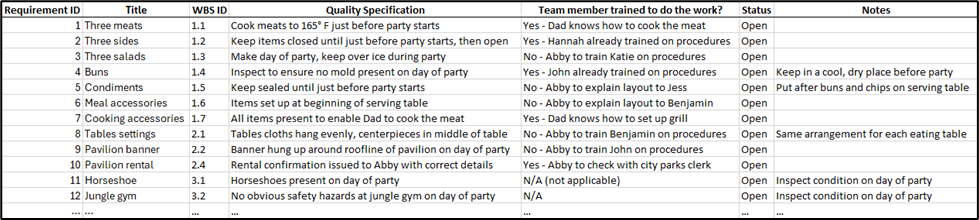
               Abby had already written about who she had available to help, what work each person would do (their roles on the project), and now she added what training to provide for those roles her friends would perform. She also wrote down how she would coach and help anyone who needed pointers on how to do their work better. It was important to Abby to lead by example wherever she could, so she would demonstrate how to do something when needed. There were a few jobs that she wouldn’t be able to do that for, though. Her dad knew more about grilling meat than she did, and she didn’t feel comfortable doing that job because of how hot the grill would get. This is an example of a project manager having to trust a subject matter expert (SME for short) to perform their specialized work and report the results [18]. In this case, Abby ensured her dad had a meat thermometer to confirm everything was cooked to the right temperature. Project managers must trust SMEs to come through for them on almost any real-world project, although the project manager should review work data and metrics (like the meat temperature as measured by the thermometer) to ensure that the work is being done to an acceptable level of quality as required to make the project succeed.


[18] Abby’s dad being a SME here has nothing to do with his role as a project sponsor. Sponsors typically don’t also play a SME role on the same project, but it’s not necessarily prohibited. The same applies regarding Abby’s mom making the birthday cake, which is not part of her role as project sponsor. Projects typically only have one sponsor; the existence of two sponsors in the story is due to both parents helping with the party.


Abby’s requirements traceability matrix again, now with training comments added.


               Now that Abby felt like she had drafted a good plan for managing her team, she reviewed how she was managing the outside help for the project. The local party shop was providing the bouncy castle and the city park department was renting out the pavilion, including the grill and eight large picnic tables. Thinking ahead about how to further manage and interact with vendors for the project, she looked through her procurement management plan again. In this plan, Abby wrote about how she planned to work with the vendors just before and during the party, what information was important to document or verify at a given time, and how to account for procurement expenditures and performance after the party was done [19].


[19] In most companies, a list of accepted or preferred vendors is kept, and often, vendors have to go through a process of interviewing with a company before even being considered for hire. Similar to this process, Abby had earlier researched three different party shops in the area, selecting the one with the best price, and that had recently done a good job at some other parties in the neighborhood. If they did a good job at Nathan’s party, Abby would be likely to consider them first for helping to throw other parties in the future – they would become a preferred vendor.


               With plans for how to manage both her project team and outside vendors who would contribute special deliverables to the project, Abby compared these plans to her quality management plan started earlier, thinking through how she would help team members work to the right level of quality as they set up the party. You would think this simply meant she needed to ensure everyone’s work met some kind of minimum standard, but interestingly, it would be possible for people to work with quality that was too good as well. The problem with improving quality too much is that after a certain point, doing a better job on something doesn’t really make it a better product. Working on something beyond when it’s good enough for the needs of the project often leads to wasted time and sometimes wasted material resources and money; working on a deliverable to make it nicer than it needs to be to meet project requirements is called gold plating. Abby’s friends who decorate the tables could use a ruler to ensure that precisely equal amounts of tablecloth hang over each side of the table, but this level of exactness would clearly be unnecessary when they can just eyeball it and still make the table look nice. So, Abby wanted to think through how her team would do a good job without spending all day trying to make each deliverable perfect.


Remember that with quality, it’s not about producing a perfect product, but about producing a product that meets a project’s requirements, both on paper and in how well the final product functions. To make sure this would happen for everything in scope for the party, Abby would need to know what things to inspect, how to inspect them and what inspection measurements would indicate that each scope item was done “well enough”. The quality management plan would be Abby’s plan for determining exactly what work to inspect, how to inspect that work and fix any issues, and why that work item needed inspection. As an example:


-        Inspect the temperature of meat on the grill to ensure it’s fully cooked before serving

-        Inspect by inserting the food thermometer into each piece of meat to take a reading

-        Keep cooking the meat if it’s not yet cooked to a safe temperature and re-check it soon

-        This work item needs to be inspected to ensure the safety of the food the party guests will eat


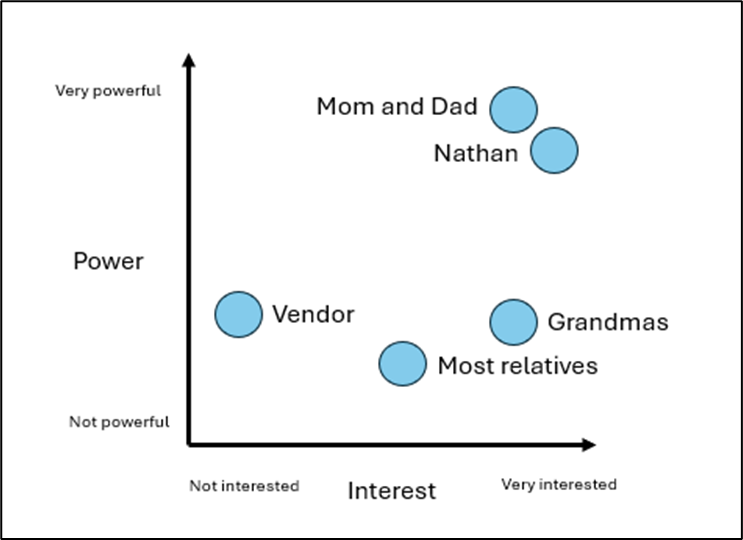
Next, Abby thought some more about the involvement of people who would attend the party. Not just Nathan and his friends, but relatives who would be there. Some of them would just show up at the right time and place, have a great time and then go home at the end of the party. A few of these people, however, would have an interest in how the party was coming together, and how it would go, and they would ask about the party before it took place. They might even want to try to influence the party preparations or become directly involved. How would Abby assess these people and make sure they stayed happy but didn’t interfere with her project? This is where Abby would need to update her stakeholder management plan, to identify the interest level of people coming to the party and their level of influence over the project. Plotting people on a stakeholder power/interest grid like the one below gave Abby a convenient way to remind herself of the influence each stakeholder had. While Abby was primarily focused on making sure Nathan really enjoyed his party, she wanted to make sure everyone else who was invited would have a great time, too.


Power/interest grid including various stakeholders or stakeholder groups.


               The possibility of an overly concerned relative trying to steer the party too much for Abby got her thinking, “This may or may not happen. I really can’t say yet, but I want to give it some thought and be ready with a good response in case it does.” She then thought a step further, “There are a lot of different things that could influence the party one way or another, not just the people around it. There isn’t a guarantee, but things could happen.”


               Abby revisited her risk management plan established earlier – the possibility of someone trying to get too involved with the party was a risk identified from analyzing her stakeholders. She recalled that different domains of project management are interrelated and a fact or change in one domain often requires updates of plans or information in other domains. A realization in stakeholder management required Abby to make an update to her risk management documentation.


--- 


               Once finished with her updates, Abby piled all these plans that she had finally completed into a big stack. A tremendous amount of work had been put into developing these, but she was finally ready to start putting together this big party for Nathan. All these individual, topic-focused plans combined to give Abby all the information she would need to navigate any situation that could unfold while getting the party ready, and they gave Abby a big picture view of what putting on the party would look like. Putting all these specific plans together as one big plan, Abby had finally finished producing the project management plan that she had started earlier on in the project!


As things would change, Abby would keep making both major and minor updates to her plans as needed. She found that for each change, she would have to review her plans for a minute to see how the change would affect each part of the project, and how each plan instructed her and her team to respond. The process of assessing these change impacts across different parts of the project more fully describes project integration management, which is an iterative process that is always happening until the project is complete. To keep her from being constantly distracted with all these updates, Abby set aside an hour each morning to review the changes and progress made the day before and to ensure that her project documentation was updated accordingly, and that she hadn’t forgotten to take any actions per the directions of her project plans.


Before starting the work of setting up the party with her friends, Abby held a planning gate review with her sponsors. She wanted Mom and Dad to see all that she was planning to do, and to ensure they agreed that Abby and her friends were ready to start carrying out those plans. Things Abby reviewed with her parents included the scope of what she and her friends would provide for the party, the planned timing of the work, and a final review of how much it was expected to cost. Along with that, Abby reviewed specific quality metrics that would be measured and how she planned to address the main risks to the party’s success. After all of this was discussed, Abby’s parents were confident that Abby and her friends were well prepared to throw a great party for Nathan. They approved the project to continue forward into the next phase!


Drop Me a Line, Let Me Know What You Think

© 2026 Accelerated Learning, LLC.

bottom of page